So I keep landing on that one moment in the briefing. You finally trace the thing back, the habit, the attachment, whatever's been feeding the compromise, and you don't find a behavior. You find a question. You're standing in front of it asking, why does this thing have this much power over me?
Erin Dunn:And the answer Brandon gave reframes the whole struggle. Nobody slides into ruinous compromise because they ran the numbers and it won. Somewhere along the line, that thing started giving orders. And somewhere along the line, we started obeying.
Patrick Nash:That's it. It stops being a willpower problem and becomes an authority problem. Something got promoted onto the throne of our decisions, and it's issuing commands we follow without ever saying the word worship out loud.
Erin Dunn:Which means the real question isn't how do I stop doing this. It's who's actually in command here, and when did I hand over the rank.
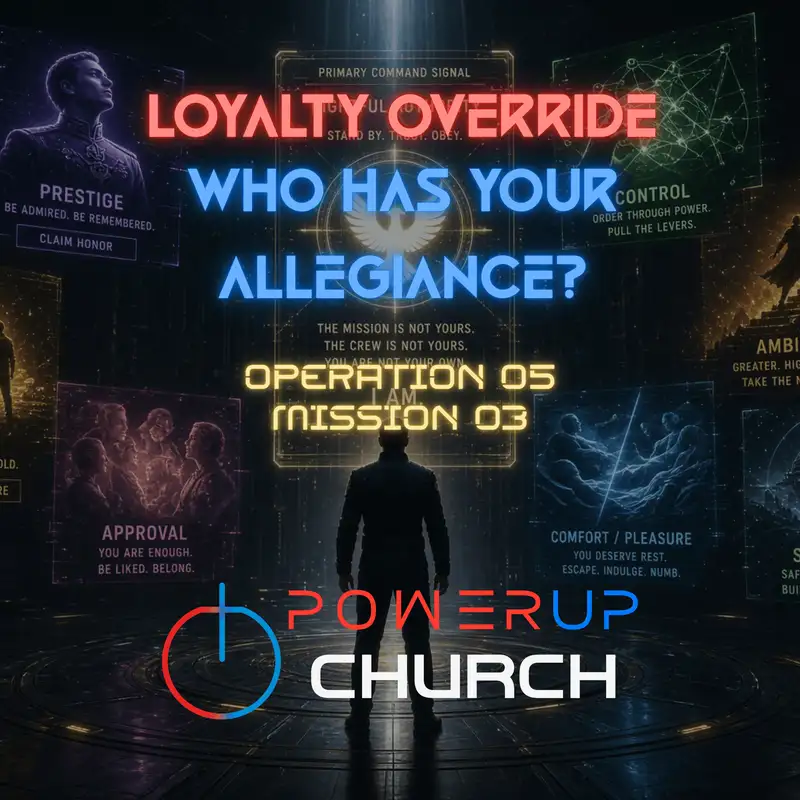
Patrick Nash:Hey, crew. Patrick here alongside Erin, and welcome back to The Ready Room Broadcast. This is our after action report on Mission three, LOYALTY OVERRIDE.
Erin Dunn:We're working through the briefing fleet commander Brandon delivered, where he pulled idolatry out of the museum and into the ordinary week. Strip away the golden calves and the carved images, and idolatry is whatever we trust, fear, protect, obey, or depend upon in ways that belong to God alone. Today, we're tracing that trust, confronting the fences we've built around it, and talking about what it looks like to restore Christ's preeminence in our actual lives, not just in our statement of faith. I want to start where the briefing starts because everything else hangs on this. Most of us were trained to hear the word idolatry and picture ancient people kneeling in front of carved wood and stone.
Erin Dunn:And Brandon's honest about what that picture does. It lets the modern believer off the hook entirely. If an idol requires a shrine, we're all innocent. We check the box, move on, and never once examine the invisible thrones governing us.
Patrick Nash:And Paul refuses to leave that door open. In the opening of his letter to the Romans, he describes idolatry as an exchange, a downgrade of worship from the creator to something created. And what struck me is that he never says these people stopped worshiping. They exchanged worship. Humans are worshipers by design.
Patrick Nash:The question was never whether we'd worship, it's what we'll worship when the moment comes.
Erin Dunn:Paul lays out the machinery of that exchange in Romans chapter one verses 21 through 25, and you can hear the descent in it, knowing God, refusing to honor him, hearts darkening, and finally trading the truth for a lie. For although they knew God, they did not honor him as God or give thanks to him, but they became futile in their thinking and their foolish hearts were darkened. Claiming to be wise, they became fools and exchanged the glory of the immortal God for images resembling mortal man and birds and animals and creeping things. Therefore, God gave them up in the lusts of their hearts to impurity, to the dishonoring of their bodies among themselves, because they exchanged the truth about God for a lie and worshiped and served the creature rather than the creator who is blessed forever.
Patrick Nash:Worshiped and served. That's the pairing in the passage that does the work. Because worship has always been an act of service, and service has always been an act of submission. Whatever you serve, you obey. Whoever holds authority in your life receives your compliance.
Patrick Nash:And that's why Paul can list envy, strife, deceit, all of it at the end of that chapter. He treats those behaviors as fruit, not root. People couldn't stop committing them because they were flowing out of an authority problem nobody was naming.
Erin Dunn:So when Paul says God gave them over, it's not a lightning bolt. It's the natural consequence of a worship transfer. Give something authority over your life long enough, and it starts reshaping you into its image. You become what you behold.
Patrick Nash:Which means you can't fight an enemy you've defined out of existence. Once we accept that idolatry operates entirely without shrines, the question changes, and it gets personal fast. Because now we have to ask what in the ordinary course of an actual week holds authority over us.
Erin Dunn:That was the move that got me. How do you actually find a functional god? Brandon says you don't start with your statement of faith because our statements of faith are usually orthodox and often irrelevant to this question. You start with evidence. Authorities reveal themselves in the patterns of their decisions.
Patrick Nash:Yeah. And the evidence is collisions. When God's claim on you and something else's claim both come due in the same moment, whichever one wins is the functioning authority in that area. Every one of us has a running record of those moments. We just rarely read it.
Erin Dunn:And the fastest way to expose the pattern is to follow your trust because trust is the currency of allegiance. Whatever you run toward in a crisis, whatever claims you when nothing else can, whatever you secretly believe would fix your life if you just had enough of it, that's where your trust actually lives, regardless of what your theology says on paper.
Patrick Nash:Jesus refuses to let us file this under money management. During the Sermon on the Mount, he makes it an outright authority declaration in Matthew chapter six verse 24. No one can serve two masters for either he will hate the one and love the other, or he will be devoted to the one and despise the other. You cannot serve God and money.
Erin Dunn:Notice he doesn't say serving two masters is difficult or inadvisable. He says it's impossible. Two authorities that both demand everything can't both get everything. When their claims collide, one backs down, and the one that backs down has just been outed as the servant.
Patrick Nash:He named money because Mammon is one of the most universal rivals in history. It promises security, freedom, significance, comfort, all things only God can actually deliver. But don't leave the principle trapped in your bank account. Fear of man runs the same circuit. If you can't make a godly decision because of what a certain person might think, that person's opinion has authority over your obedience.
Patrick Nash:You've got a master arrangement you never consciously agreed to.
Erin Dunn:Approval functions like a god for a lot of people who'd be genuinely offended by the suggestion. A career can take the seat, a political identity, even family. A good gift promoted past god becomes a source of divided commands. So here's the diagnostic honesty the briefing asks for this week. The question isn't, do I trust God?
Erin Dunn:We'd all say yes. The question is, what else do I trust alongside him? And what do I trust instead of him when the pressure's real?
Patrick Nash:And that matters because trust that only operates when circumstances are calm isn't really trust in God. It's confidence in circumstances wearing God's name as a label. But trace it far enough, and you hit something stranger than misplaced confidence.
Erin Dunn:Right. You discover you haven't just been leaning on this thing. You've been guarding it.
Patrick Nash:That's where this mission stops being comfortable for me. The elders who come to Ezekiel in chapter 14 look like seekers. They showed up to inquire of the Lord. From the outside, men approaching God with open hands. And before God answers a single question, he makes them look at what they carried in with them.
Erin Dunn:It's such a careful distinction in the passage. They'd taken their idols into their hearts, not into their houses, into their hearts. Religious men with secret thrones, approaching the true God while protecting rival allegiances. And God tells Ezekiel exactly how he'll respond to men like that. Hear it in Ezekiel chapter 14 verses three through five.
Erin Dunn:Son of man, these men have taken their idols into their hearts and set the stumbling block of their iniquity before their faces. Should I indeed let myself be consulted by them? Therefore speak to them and say to them, thus says the Lord God, any one of the house of Israel who takes his idols into his heart and sets the stumbling block of his iniquity before his face and yet comes to the prophet, I, the Lord, will answer him as he comes with the multitude of his idols that I may lay hold of the hearts of the house of Israel who are all estranged from me through their idols.
Patrick Nash:He answers them according to the multitude of their idols, not according to the piety they presented at the door, according to the loyalty they hid behind it. God is not confused about where our actual allegiance sits. He reads the heart.
Erin Dunn:And his stated purpose is that they may know that I am the Lord. He exposes the divided house, captures the heart that set up rivals, so that the people who claim to belong to him would know finally and undeniably that he does not share his position. That's sobering. But the way Brandon handled it pastorally is what stayed with me. Tracing your trust finds the rival, but it doesn't deal with the wall around it.
Erin Dunn:Protected ground is the part of your life you've effectively exempted from God's authority. The relationship you won't submit to his word even though you know what his word says. The habit that stays while everything else negotiates, the finances that are his until the number gets uncomfortable.
Patrick Nash:The grudge you've labeled closure and refuse to hand over. And here's the tale. The moment God's claim touches that boundary, watch your heart. Defensiveness, anger, a sudden flood of reasons why this one is different. That reaction is diagnostic.
Patrick Nash:We don't fight for what we don't treasure, and you don't post a guard on territory nobody wants. The intensity of the defense reveals the size of the idol.
Erin Dunn:I appreciate that the briefing leans pastoral right there because this is where people either panic or pretend. Finding protected ground in your own heart isn't the discovery that you were never really a believer. It's the discovery that consecration is still in process, which is the entire point of this operation since mission one.
Patrick Nash:God identifying the fence is mercy. He could let the divided loyalty sit there quietly for decades, feeding compromise and costing the mission. Instead, he comes after it. The man in Ezekiel's picture was caught, captured, reclaimed. That's invasion language, but it's rescue language too.
Patrick Nash:Because the alternative is leaving you with a rival that will eventually demand what it always demands, everything.
Erin Dunn:So once you've stood at the fence and admitted the throne inside it, only one question remains. What gets done about it?
Patrick Nash:And that's the turn the briefing takes into the fourth movement. What idolatry corrupts, the gospel restores. The whole sweep of this operation has been driving toward one transaction, the transfer of authority back to its rightful holder.
Erin Dunn:Which could feel like a grim cleanup project, except Paul refuses to let us see it that way. In his letter to the Colossians, he gives us a portrait of the rightful holder, and it reframes the entire conflict. Dethroning our functional gods was never about creating a vacancy. It's about recognizing the king who has no rival and never did.
Patrick Nash:And the portrait is extravagant. Everything created, visible and invisible, thrones, dominions, rulers, authorities created through him and for him. He's before all things holding it all together. And then Paul lands on the phrase, the whole mission aims at, that in everything he might be preeminent. First in rank, first in authority, first in claim, not first among equals, first, full stop.
Patrick Nash:Hear how Paul describes him in Colossians chapter one verses 15 through 18. He is the image of the invisible God, the firstborn of all creation. For by him, all things were created in heaven and on earth, visible and invisible. Whether thrones or dominions or rulers or authorities, all things were created through him and for him. And he is before all things and in him, all things hold together.
Patrick Nash:And he is the head of the body, the church. He is the beginning, the firstborn from the dead, that in everything he might be preeminent.
Erin Dunn:What that does to the Romans one scandal is remarkable. The one whose authority we traded away for cheap substitutes is the one who made the substitutes in the first place. He isn't competing for your allegiance the way an underdog campaigns for votes. He's the creator of your money, your relationships, your ambitions, your fears. They exist because he spoke.
Erin Dunn:So claiming absolute authority over your life isn't his ambition. It's just the truth of the universe functioning correctly.
Patrick Nash:So restored allegiance looks like demotion. Every rival comes down off the wall. The fences of objective three come apart section by section. The will stops negotiating exemptions and starts saying everything, Lord, including that. Here's what it doesn't look like.
Patrick Nash:Trying harder to want God more than you want the other things. Willpower has never once in human history solved a worship problem.
Erin Dunn:What actually happens is a receding of trust, putting the full weight of your dependence on Christ instead of the substitute. And then it plays out decision by collision. He says, forgive and every instinct demands the grudge. Allegiance answers. He says, give and every instinct says, keep.
Erin Dunn:Allegiance answers. He says speak and fear of man says stay quiet, Allegiance answers. That's not legalism. That's a kingdom functioning the way a kingdom functions with a king who's actually obeyed.
Patrick Nash:And the surrendered life isn't the sad life where you lost your treasures. It's the ordered life where everything good finally serves the one who gave it instead of trying to take his seat. That surrender is the runway into the week because allegiance isn't restored in a moment of emotion. It's restored in a week of decisions. So let's walk the crew through the week.
Patrick Nash:On Monday, take inventory, but not of behaviors, of authority. Get alone with a notebook or your phone and walk through the last month looking for collisions. Moments where you knew what God was asking and something else won instead. Write down what won. Don't editorialize.
Patrick Nash:Don't explain it away. Just log the data.
Erin Dunn:Some of us will fill half a page. Some will find one entry that makes the stomach drop. Either way, you now have a map, and you can't surrender ground you've never located. Tuesday builds on it. Take that list before God and make it a confession session rather than a strategy session.
Erin Dunn:Name each item out loud as what it actually is, an allegiance that belonged to him alone.
Patrick Nash:And don't rush it. The briefing leans on Psalm 32 here, that the silence after unconfessed sin costs more than the confession ever does. The enemy's old trick is convincing you the thing protecting you from embarrassment in that moment is worth keeping. It isn't. Confession is where the demotion of your rivals legally begins.
Patrick Nash:David describes both sides of that equation in Psalm 32 verses three through five. For when I kept silent, my bones wasted away through my groaning all day long. For day and night, your hand was heavy upon me. My strength was dried up as by the heat of summer. I acknowledged my sin to you, and I did not cover my iniquity.
Patrick Nash:I said, I will confess my transgressions to the Lord, and you forgave the iniquity of my sin.
Erin Dunn:By Wednesday, you've inventoried and confessed, so go hunting for the fence. Ask God a specific question. Lord, where have I told you everything but this? Then sit quietly long enough for him to actually answer. He usually brings something to mind inside the first sixty seconds, and it's usually the thing you hoped he wouldn't bring up.
Erin Dunn:Once you've identified it, write down every rationale you've been using to justify it. Those rationalizations are mission two territory. Permissions, exemptions, shifted boundaries, and seeing them in your own handwriting tends to dissolve their power remarkably fast.
Patrick Nash:Thursday is the perimeter test. Take one area from the Monday list, just one, the clearest one, and deliberately obey God where you'd normally obey the rival. If approval was winning, do the God honoring thing knowing somebody will disapprove. If mammon was winning, be generous in a way that costs you something real. One collision walked into deliberately with your allegiance assigned before it happens.
Patrick Nash:That single act of obedience will teach your heart more about worship than a 100 sermons.
Erin Dunn:Friday makes it concrete. Bring one protected area to a believer you trust, someone who'll speak the truth rather than just sympathize, and ask them to hold you accountable in that territory. It'll feel enormously vulnerable if you've never done it. Do it anyway. Divided loyalty thrives in secrecy and starves in the light.
Erin Dunn:Community isn't a nice addition to consecration. It's one of the delivery systems God actually uses.
Patrick Nash:Then Saturday, review the whole week. Pull out the Monday list and mark what you've actually acted on and what still stands guarded. Thank God honestly for the ground taken. Gratitude seals what guilt only wounds. Then pick the next single territory and walk out the same pattern next week.
Patrick Nash:This is slow work, and it's supposed to be. Because God isn't clearing a room, he's retaking a kingdom. Inventory, confession, confrontation, obedience, accountability, reinforcement. And by week's end, you won't merely have thought about allegiance. You'll have repositioned some of it back where it belongs.
Erin Dunn:Pulling it all together, we came into this mission off the trail from mission two, Contamination Trace, where we followed compromise back through permissions and rationalizations to its source. And mission three confronted what was actually waiting there, not merely a bad habit, but a transfer of authority. We traced the trust and found what governs our decisions when the claims collide. We stood in front of our protected ground and admitted we built fences God was never invited to pass. And then we turned and saw the king, preeminent before all things and over all rivals.
Patrick Nash:And the goal was never an emptied throne. It's a throne with its rightful occupant restored, which raises the question the briefing leaves us with, doesn't it? Okay. This area belongs to God now. So what does belong fully to God actually look like on a Tuesday afternoon?
Patrick Nash:Allegiance restored creates a reordering task because the whole configuration of the surrendered life has to be arranged around his authority, not just swept clean and left vacant.
Erin Dunn:That's where we're heading, and it's the right next step because clearance is not finished product, consecration is. There's one line from Paul's Portrait of the King worth carrying into the week. The phrase the whole mission has been aiming at in Colossians chapter one verse 18, that in everything he might be preeminent.
Patrick Nash:So hold the ground you took this week. Stay honest about the fences still standing. We'll see you back here in The Ready Room Broadcast. Until then, keep charting new faith frontiers, keep exploring God, and keep empowering people.
Erin Dunn:See you next time, crew.