There's a point where asking God for more clarity stops being discernment. You already know what he's confronting. You already know where the warning is coming from. The question is whether you're going to respond to it.
Patrick Nash:And that's uncomfortable because clarity takes away one of our favorite forms of protection. As long as something feels uncertain, we can keep examining it. We can keep praying about it. We can keep telling ourselves we're still trying to figure out what God wants.
Erin Dunn:But what happens when you're not confused anymore?
Patrick Nash:Then the issue isn't whether you understand the hold. The issue is whether you're willing to clear what caused it.
Erin Dunn:Which means sometimes the most important movement in your faith starts when God says, you're not proceeding with this still attached.
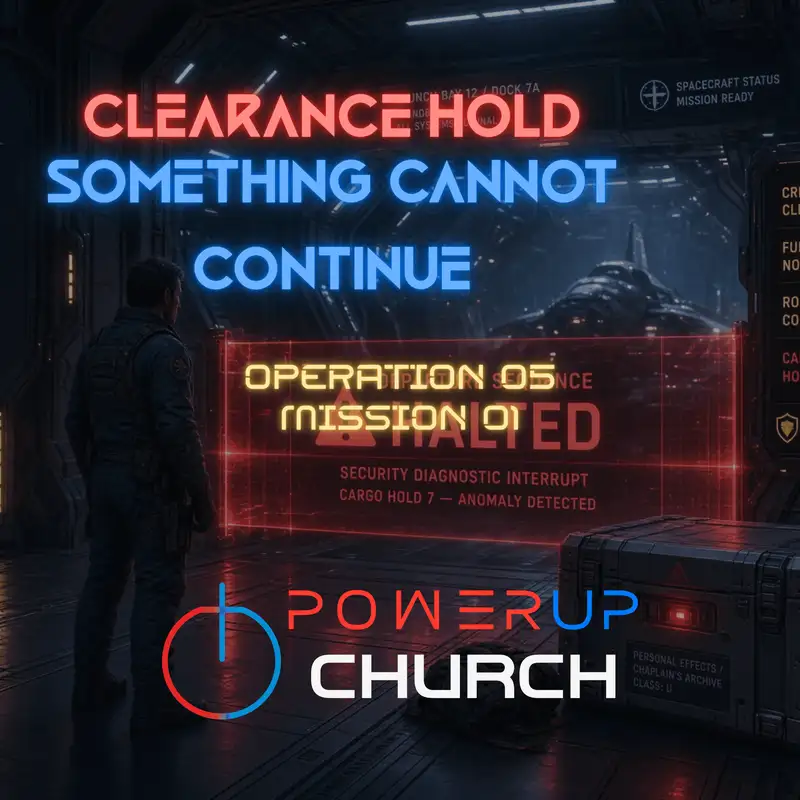
Patrick Nash:Hey, crew. Patrick here with Erin, and welcome back to The Ready Room Broadcast. This is our after action report on mission one of Operation five. Clearance protocol, clearance hold. Something cannot continue.
Erin Dunn:And this mission marks a real progression from where the campaign has been. Operation four dealt with formation, calibration, identity, character, structure, mission readiness, and whether the frame could actually carry the load. Clearance protocol starts asking what happens after something has been exposed and identified. What do you do when the issue is no longer hidden?
Patrick Nash:That distinction matters. The briefing was very careful not to turn clearance into some kind of spiritual performance system. This isn't about earning salvation or becoming good enough for God to finally accept you. The entire framework is about surrendered readiness. You belong to Christ, and because you belong to him, whatever contradicts that allegiance can't simply be granted permanent residence.
Erin Dunn:And that changes the way you hear a hold. A hold doesn't automatically mean the mission has been canceled. Sometimes it means something has been identified that has to be resolved before you keep moving.
Patrick Nash:So let's start there. Because if you misunderstand the hold, you'll probably misunderstand everything God is doing through it.
Erin Dunn:One of the strongest distinctions in the briefing was between conviction and condemnation. Those can feel similar when you're the one being confronted. Something surfaces, God puts his finger on it, and your first reaction may be, well, I've ruined everything.
Patrick Nash:Yeah. Exposure can feel final even when it isn't. You see the resentment you've normalized, the habit that's become routine, the control you keep defending, the private compromise you've learned to manage, and suddenly your mind jumps from God is confronting this to God must be finished with me.
Erin Dunn:And the briefing pushed against that pretty hard. If God is revealing something because he intends to lead you toward repentance, healing, obedience, and freedom, then the exposure itself can actually be mercy.
Patrick Nash:That doesn't make it pleasant.
Erin Dunn:No. Mercy isn't always comfortable.
Patrick Nash:But it changes how you respond. If I believe conviction means God is rejecting me, I'm probably going to hide. I'll defend myself. I'll explain why the problem isn't really the problem, or I'll spiral into shame and make the whole moment about how terrible I am.
Erin Dunn:Whereas if I understand that God is showing me something because he intends to lead me, then I can ask a much healthier question. What are you showing me?
Patrick Nash:And that's where the language of inspection becomes useful. You're not trying to inspect yourself until you can prove you're spiritually clean. You're allowing God to search what you may have become very skilled at protecting.
Erin Dunn:David gives language for exactly that posture in Psalm chapter 139 verses twenty three and twenty four. He isn't telling God what he's allowed to find. He's opening the entire interior life to God's examination. Search me, oh God, and know my heart. Try me and know my thoughts, and see if there be any grievous way in me, and lead me in the way everlasting.
Patrick Nash:What strikes me there is the willingness involved. You don't pray that kind of prayer while holding a list of exemptions.
Erin Dunn:Right. You can't really say, search me, but not this relationship. Search me, but don't touch that resentment. Search me, but this coping mechanism stays. Search me, but I've already decided my explanation for this behavior is final.
Patrick Nash:And I think that's where people can get stuck. We want God to explain why we feel bad without necessarily authorizing him to change what the feeling is pointing toward.
Erin Dunn:Or we want reassurance before surrender. Tell me I'm okay first, and then maybe I'll look at what you're confronting.
Patrick Nash:But the reassurance is actually found in the character of God. The hold isn't proof that he abandoned the mission. The briefing says the opposite. Sometimes the hold protects what God is preparing you to carry because he refuses to let an unresolved condition quietly become part of your operating system.
Erin Dunn:And once you can receive the inspection without immediately translating it into rejection, you become capable of something much harder.
Patrick Nash:Naming what God actually found.
Erin Dunn:The briefing used a phrase I think is painfully accurate. Vague repentance produces vague change.
Patrick Nash:Because vague language gives us room to avoid the actual issue.
Erin Dunn:I need to do better.
Patrick Nash:I've got some stuff to work on.
Erin Dunn:I've been struggling spiritually.
Patrick Nash:All of those could be true, but they can also be fog.
Erin Dunn:And fog is convenient when the obstruction is something you don't want to see clearly.
Patrick Nash:This is where the briefing gets very specific. If it's pride, call it pride. If it's dishonesty, call it dishonesty. If it's bitterness, call it bitterness. Don't rename control as leadership or manipulation as caring too much.
Patrick Nash:Don't rename avoiding responsibility as waiting on God.
Erin Dunn:That kind of specificity can sound harsh until you remember what makes confession possible in the first place, mercy.
Patrick Nash:That matters. We don't have to soften the report because God already knows the actual condition. We're not protecting him from information.
Erin Dunn:We're usually protecting ourselves from the implication.
Patrick Nash:And that's why confession is more than admitting something went wrong. It's the point where you stop defending what God has identified.
Erin Dunn:The briefing anchors that in Proverbs chapter 28 verse 13, where concealment and confession are placed on opposite sides of the response. Whoever conceals his transgressions will not prosper, but he who confesses and forsakes them will obtain mercy.
Patrick Nash:Once you name something honestly, you can start seeing what it's connected to.
Erin Dunn:That's an important step because the behavior itself may not be the whole story. You name anger, but then you start noticing what activates it. You name comparison, and suddenly you can see the material you keep consuming that feeds it. You name dishonesty, and then you have to look at what you're afraid will happen if you tell the truth.
Patrick Nash:Or you name control and realize how much of your life has been organized around preventing outcomes you're afraid to entrust to God.
Erin Dunn:And sometimes you need someone else to help you see it.
Patrick Nash:The briefing's treatment of accountability was good here because it didn't define accountability as surveillance. It wasn't give another believer control of your conscience. It was about allowing trustworthy believers to speak into areas where your own explanations may no longer be reliable.
Erin Dunn:Which is humbling because if you've lived with a pattern long enough, it can stop feeling like a pattern.
Patrick Nash:It starts feeling normal.
Erin Dunn:Or justified.
Patrick Nash:Or permanent.
Erin Dunn:And that's why somebody may need to ask the question you've gotten very good at avoiding. Why do you keep returning to that relationship? Why does correction make you defensive? Why does this particular subject always trigger anger? Why do you keep rebuilding access to something you say you want freedom from?
Patrick Nash:Those aren't comfortable questions, but clarity creates responsibility. Once the obstruction has a name, you can't honestly pretend you don't know what God is confronting.
Erin Dunn:And that's when the temptation changes.
Patrick Nash:Because once you can't hide behind vagueness anymore, the next move is usually negotiation. I think this may be the sharpest part of the entire mission. There's a time when I'm praying about it is faithful discernment, and there's a time when I'm praying about it means I don't like the answer.
Erin Dunn:That line can be hard to admit.
Patrick Nash:It is because delay can sound very spiritual. I'm waiting for peace. I need another confirmation. I wanna make sure I've really heard God.
Erin Dunn:And sometimes you genuinely should slow down and discern. The briefing didn't attack discernment.
Patrick Nash:No. The issue is when the clarity has already arrived and we keep asking for another signal because we want a different answer.
Erin Dunn:Or because obedience is going to cost us something.
Patrick Nash:That's where negotiation gets attractive. Most believers aren't trying to stage some dramatic rebellion against God. We want a compromise that can survive inside Christian vocabulary.
Erin Dunn:Partial surrender that still sounds faithful.
Patrick Nash:Jesus can be Lord, but we'd like one compartment under local control.
Erin Dunn:And the hard thing about that is we can keep asking God to fix the consequences of the very thing we're refusing to surrender.
Patrick Nash:We want peace while protecting what destabilizes us. We want freedom while preserving access. We want healing without telling the truth about what keeps reopening the wound.
Erin Dunn:James doesn't leave much room for passive negotiation. The briefing brings us into James chapter four, verses seven through 10, where submission to God, resistance, cleansing, repentance, humility, and drawing near to him all move in the same direction. Submit yourselves therefore to God. Resist the devil and he will flee from you. Draw near to God and he will draw near to you.
Erin Dunn:Cleanse your hands, you sinners, and purify your hearts, you double minded. Be wretched and mourn and weep. Let your laughter be turned to mourning and your joy to gloom. Humble yourselves before the Lord and he will exalt you.
Patrick Nash:There's movement in that response. And I think that's important because repentance can become this endless emotional analysis where we assume we haven't really repented unless the struggle disappears.
Erin Dunn:The briefing made a much more practical distinction. Repentance isn't proven by the absence of struggle. It's demonstrated by change direction in the middle of the struggle.
Patrick Nash:That gives you permission to obey before obedience feels easy.
Erin Dunn:You may still grieve what you're leaving.
Patrick Nash:You may still feel the pull of the habit.
Erin Dunn:You may still wish the relationship could have been different.
Patrick Nash:You may establish the boundary while part of you wants to remove it.
Erin Dunn:The emotional attachment doesn't get final authority simply because it's still there.
Patrick Nash:And that's especially important when we're dealing with familiar sin or familiar coping mechanisms. Familiarity can make something feel necessary.
Erin Dunn:Sometimes even safe.
Patrick Nash:Even when it's doing damage.
Erin Dunn:So waiting for the temptation to become unattractive may mean waiting forever. The question becomes whether that temptation gets more authority than Christ.
Patrick Nash:And once that negotiation ends, you eventually have to do something concrete.
Erin Dunn:Which is where clearance stops being theoretical. Repentance that never reaches our decisions eventually becomes sentiment.
Patrick Nash:That line gets practical fast.
Erin Dunn:Because at some point, there has to be evidence that a different direction has been chosen.
Patrick Nash:Not instant perfection. That distinction needs to stay in place, but you stop designing your environment to make disobedience easy.
Erin Dunn:This is where the briefing gave example after example of the contradiction we can live in. Praying for purity while preserving every trigger, Praying for freedom from comparison while constantly consuming what feeds comparison. Asking God for financial discipline while refusing to change the behavior creating the crisis.
Patrick Nash:Asking God to help you stop while quietly making sure you can restart.
Erin Dunn:That one, Lance.
Patrick Nash:Because sometimes the access itself is the obstruction. Not every situation can be solved by changing an environment, but sometimes obedience really does look that practical. Delete something, block something, cancel something, change the routine, establish the boundary, tell the truth, bring somebody else into it.
Erin Dunn:And I think the briefing was wise to widen the category slightly here too. Sometimes the thing slowing you down is clearly sin. Other times, it may be a weight, something that isn't necessarily described in exactly the same way, but still hinders faithful endurance.
Patrick Nash:Which is why Hebrews chapter 12 verses one and two fits this part so well. The image is movement, laying aside what clings and what weighs you down, running with endurance, and keeping your attention fixed on Jesus. Therefore, since we are surrounded by so great a cloud of witnesses, let us also lay aside every weight and sin which clings so closely, and let us run with endurance the race that is set before us, looking to Jesus, the founder and perfecter of our faith, who for the joy that was set before him endured the cross, despising the shame, and is seated at the right hand of the throne of God.
Erin Dunn:That last part keeps this whole operation from turning into obsessive self inspection.
Patrick Nash:Yeah. The goal isn't to become fascinated with everything that's wrong with you.
Erin Dunn:The goal is Jesus.
Patrick Nash:You remove what obstructs obedience because you belong to him. You confront competing loyalties because he's lord. Holiness isn't just increasingly sophisticated avoidance of a prohibited things list. It's increasing availability to Christ.
Erin Dunn:And availability requires room.
Patrick Nash:That may be one of the most important implications of this mission. You can ask God for greater responsibility while gripping something he already told you to release. You can ask for deeper intimacy while protecting private compromise. You can ask for new mission coordinates while insisting on carrying unauthorized cargo from the previous sector.
Erin Dunn:And some of that cargo has history.
Patrick Nash:Which means releasing it can involve grief.
Erin Dunn:A habit may have started as a coping mechanism. A defense may have developed because something genuinely hurt. A relationship can contain real memories and still be unhealthy in its present form.
Patrick Nash:The briefing didn't deny any of that. It actually made room for it. God can understand why something developed while still saying it cannot govern where you're going.
Erin Dunn:He can care about the wound and still confront the weapon you built around it.
Patrick Nash:So clearing the obstruction isn't pretending the history never mattered. It's deciding the history doesn't receive command authority over the future. This mission gives the crew six actions to carry through the week, and I like the progression because each one builds on the previous one. It begins with request the inspection.
Erin Dunn:Set aside uninterrupted time with God and actually make room for Psalm 139 verses twenty three and twenty four. Don't manufacture guilt. Don't walk in already determined to accuse yourself of something. Ask God to show you what he's already been confronting. And when something becomes clear, write it down.
Patrick Nash:That posture is worth returning to. So bring Psalm chapter 139 verses twenty three and twenty four back into that time intentionally. Search me, O God, and know my heart. Try me and know my thoughts, and see if there be any grievous way in me, and lead me in the way everlasting.
Erin Dunn:Then comes name the obstruction. Get specific. If the issue is anger, resentment, pride, dishonesty, jealousy, control, avoidance, lust, whatever it actually is, stop giving it language vague enough to escape through.
Patrick Nash:And look at the effects. What is it doing to your relationships, your prayer life, your integrity, your ability to receive correction, your willingness to obey?
Erin Dunn:The third action is find the access. What keeps feeding the issue? Maybe it's an account, a device, a private routine, a relationship, a spending pattern, a certain situation, or the absence of accountability.
Patrick Nash:Don't only ask why you keep going back. Look at how you keep getting back.
Erin Dunn:Then make the cut. Take one concrete action that makes obedience easier and compromise harder.
Patrick Nash:That could mean changing access, establishing a boundary, ending an arrangement, changing the routine, or confessing what you've been hiding. The point isn't dramatic action for its own sake. The point is that something materially changes because you chose obedience.
Erin Dunn:Fifth, open the channel. Bring one spiritually mature and trustworthy believer into what you're dealing with.
Patrick Nash:And choose carefully, not somebody who will excuse everything and not somebody who will control or shame you. You need someone who can handle truth and grace together.
Erin Dunn:Finally, verify the heading. Go back and look honestly at what changed. Did you remove the access? Did you rebuild it? Did the boundary hold?
Erin Dunn:Are you already looking for exceptions?
Patrick Nash:And if you stumbled, don't convert one failure into permission to abandon the mission. Confess it. Correct the heading. Reinforce what needs reinforcement. Keep moving.
Erin Dunn:Because the objective isn't to prove you achieved instant perfection in six days.
Patrick Nash:It's to establish a direction in which the thing God identified is no longer something you're committed to protecting.
Erin Dunn:I keep coming back to the fact that this operation begins with a hold. That's not usually the kind of thing people celebrate.
Patrick Nash:We like momentum, open doors, new assignments, greater capacity. We like anything that feels like movement.
Erin Dunn:But sometimes God's most protective instruction is stop.
Patrick Nash:And that doesn't mean you stop existing. It doesn't mean your calling disappeared. It doesn't mean everything God formed in you was wasted.
Erin Dunn:It means what he intends carry forward can't safely remain attached to everything you insist on carrying with it.
Patrick Nash:Which takes us back to the race language from Hebrews chapter 12 verses one and two. The mission isn't simply to stare at the weight. The weight gets laid aside so you can keep moving with your attention fixed where it belongs. Therefore, since we are surrounded by so great a cloud of witnesses, let us also lay aside every weight and sin which clings so closely, and let us run with endurance the race that is set before us, looking to Jesus, the founder and perfecter of our faith, who for the joy that was set before him endured the cross, despising the shame, and is seated at the right hand of the throne of God.
Erin Dunn:And I think that keeps this from becoming a shame message. The briefing closes by making a distinction the crew needs to hold on to. Something cannot continue does not mean you cannot continue.
Patrick Nash:That's important because exposure can become identity really quickly if you let it. I failed, so I am a failure. I compromised, so I'm permanently disqualified. I struggled, so none of God's work in me was real.
Erin Dunn:But that isn't where this mission leaves us. Because you belong to Christ, compromise doesn't receive equal ownership. Because grace is real, repentance is possible. Because mercy is available, confession doesn't have to end in despair.
Patrick Nash:And because Jesus is Lord, whatever he identifies as a rival doesn't get permanent authorization.
Erin Dunn:So don't waste the hold.
Patrick Nash:If God has already made something clear, you may not need another message about it. You may need to respond to the one you already have.
Erin Dunn:Read the hold. Name what remains. Stop negotiating. Clear the obstruction.
Patrick Nash:You don't have to know every mission coordinate that comes next. You just need enough honesty to obey the one God has already placed in front of you.
Erin Dunn:And that's where mission one leaves the crew. Not obsessed with appearing spotless, not terrified that one failure erases everything, but willing to be corrected, willing to repent, and unwilling to protect compromise simply because it's familiar.
Patrick Nash:Clearance protocol has only begun. The first diagnostic is already in front of us. What has God made clear cannot continue.
Erin Dunn:Bring that into the light. Put it under the authority of Jesus, take the next obedient step, and keep charting new faith frontiers as we explore God and empower people together. We'll see you back here in The Ready Room Broadcast.
Patrick Nash:See you next time, crew.